Showing posts sorted by date for query In a Better World. Sort by relevance Show all posts

Tuesday, January 9, 2024

2022 Winner, All Quiet on the Western Front
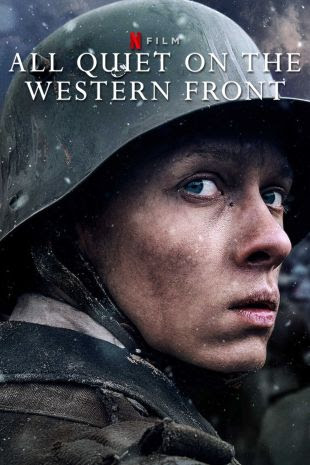
 

All Quiet on the Western Front


Director: Edward Berger

Distributed by: Netflix

Released: September 2022

Country: Germany

Shortly after the beginning of the war in October 1914, the Western Front became bogged down in trench warfare. At the end of the war in November 1918, the front line had barely moved. More than three million soldiers died here, often while fighting to gain only a few hundred metres of ground. During the First World War, almost 17 million people lost their lives.

Sorry for the spoiler, but this text is how Germany’s All Quiet on the Western Front closes. If the filmmakers had just written this at the beginning, it would have saved me and all the viewers a whole lot of time and effort. Even better, had the enemies in The Great War had this information before the power keg of Europe blew, think of the number of lives saved. 


This 2022 BFF winner is based on the 19
23 Erich Maria Remarque novel many of us were forced to read in high school (or get the Cliffs Notes, ha ha, just kidding Fr. Streicher). I have never seen the 1930 American version of this story, but while it won an Oscar for Best Picture, I would have no problem believing the German film is much better in a lot of ways. The trouble is, our 2022 version was made over 100 years after the end of the war, which sort of takes the zing our of the point of the film, which is, of course, to paraphrase American Gen. William Tecumseh Sherman, war is no bueno.

The story follows 17-year-old Paul, a naive kid who forges his parents’ signature to be able to enter the German army in 1917. Paul and his pals can’t wait to get to the front and kick France’s ass. It takes about 10 minutes after getting there for them to realize trench warfare isn’t quite as glorious as their schoolmaster had made it out to be. One of the chums, Ludwig, even cries on the first night that all he wants to do is go home. But the only way Ludwig is going home is in a body bag (I’m pretty sure they didn’t have body bags in 1917, but you get the gist).

Ferdinand Foch at the signing of the Armistace
The war drags on and the deaths pile up. Paul and his comrades engage in the kinds of things one does during wartime—scrounge for food, dream of women, talk of what they’ll do when they get back home. An older soldier, Kat, latches on to the group, a wise though illiterate man. Paul worries that the war has changed him, that life will never be the same after all he has seen. Unlike educated Paul, Kat knows getting out of this thing alive is the objective—everything else is gravy.

Simultaneously, we see the big shots behind lines working behind the scenes. On the one hand, German officials know the war is lost and are going to have to stomach some bad terms. The French coalition, led by Gen. Ferdinand Foch, are uncompromising and haughty (this is a German-made film, after all); the Germans, led by the more reasonable Matthias Erzberger (and played by Daniel Brühl, who viewers may remember from Quentin Tarantino’s Inglorious Basterds in a less sympathetic role), have no choice but to sign a bad deal. All the while, like in Stanley Kubrick’s Paths of Glory, another WWI film, the military leadership remain impervious to the sufferings of the grunts, only concerned about personal glory and fruitless ideations.

Daniel Bruhl, Inglorious Basterds
There is much to admire in this film about WWI, a conflict that seems to have been somewhat resurrected in film with Sam Mendes’s 1917 (from 2019) and Peter Jackson’s 2018 documentary They Shall Not Grow Old. More stylish and gruesome than these films, All Quiet on the Western Front draws you in and has you rooting for these ill-fated German kids. Particularly integral to the style is German composer Volker Bertelmann’s Oscar Award winning-score. Like John Williams’s remarkably simple theme from Jaws, the music here consists of only a few notes—from a distorted bass—that alert the viewer that what is coming next isn’t good. Tragedy will come from an ill-fated charge from the trenches or from the delusional words of a German general who on the last day still thinks sending the boys to fight and die is a noble undertaking.

The Title: German: Im Westen nichts Neues. Literally, In the West, nothing new.  Nothing new, indeed.

Culture: If there is one truism of History, it’s that one thing leads to another. World War I didn’t come out of nowhere and aptly serves as the run-up to the war that started in 1939. All Quiet provides a bit of a window into the wartime zeitgeist of the new-ish country that was Germany in the early twentieth century, from the rush of patriotism to the gut-punch of defeat in 1919, particularly in that train car where the armistice agreement was signed.

Agenda danger: This is what we call the classically anti-war film, plain and simple. And do we really need another anti-war film, even if is is a really well-made one? This 147-minute movie can be summed up in a simple Pink Floyd lyric:

Forward he cried from the rear and the front line died.

The general sat while the lines on the map moved from side to side.

Best Picture that year: Everything Everywhere All at Once

Rating: Recommended if you are trying to figure out if you are pro- or anti-war, or if you are in high school and would rather skip reading the novel.

Friday, December 15, 2017

My BFF Wrap-Up: My Ranking


Starting in June 2016, I watched and reviewed every winner of the Academy Award for Best Foreign Language Film, or in short, Best Foreign Film (BFF), in reverse chronological order from the 2015 entry to the awards inception in 1947 (watching the 2016 winner at the end).  Part of the experiment was to see how many of these I would be able to find.  In most cases, I was able to borrow the DVD of each film from the Cuyahoga County Library system (a consistently top rated system in Northeast Ohio), and as things went further back in time, that meant using the inter-library systems CCL employs, SearchOhio and OhioLINK.  I did have to watch a couple on the dusty old VCR.  On two or three occasions when I couldn’t find the movie through the CCL system, I was able to get DVDs from the Cleveland Public Library.  Once I paid $2 to watch a movie on Amazon, and that was the grand total of money I spent on this project.  I did find a couple rare films online, having exhausted every other possibility.  Only once was I not able to find a film at all, at least with English subtitles, and that was 1950’s The Walls of Malapaga.  I watched it only in French with Portuguese subtitles, and decided to review it anyway.

My reviews were intended for people who don’t normally watch foreign films, a group that included me not all that long ago.  I found a lot of the movies worth watching, not just ones you might see at an art house, but movies I am convinced would have been mainstream American favorites had they been in English.  I also sat through a lot of tedious, self-admiring crap that got awards for having the right political or social view to the voters of the Academy.  But enough about The Sea Inside.  My goal was to make the reviews be entertaining, especially when the movie wasn't, and to give American viewer something they could relate to.

The list here is my amateurish attempt to rank what is perhaps the unrankable.  There are a variety of genres and so many different cultures represented here that it is almost unfair to compare them against each other.  But I did anyway, and the films are listed below from best to worst.  Click any movie title to read the review.  You can follow me on Twitter at @hawley5150.   

Enjoy!

1989, Cinema Paradiso, Italy

2006, The Lives of Others, Germany

1951, Rashomon, Japan

1998, Life Is Beautiful, Italy

1957, La Strada, Italy

1949, The Bicycle Thief, Italy

2011, A Separation, Iran

1975, Dersu Uzala, Soviet Union

1967, Closely Watched Trains, Czechoslovakia

1947, Shoeshine, Italy


1963, , Italy

2009, The Secret in Their Eyes, Argentina


1983, Fanny and Alexander, Sweden

1962, Sundays and Cybele, France

1965, The Shop on Main Street, Czechoslovakia

1986, The Assault, The Netherlands


1987, Babette's Feast, France

1960, The Virgin Spring, Sweden

2002 Nowhere in Africa, Germany

1958, My Uncle, France


1968, War and Peace, Soviet Union

1957, Nights of Cabiria, Italy

2007, The Counterfeiters, Austria

1974, Amarcord, Italy

1952, Forbidden Games, France

 
1961, Through a Glass Darkly, Sweden

2014, Ida, Poland

2016, The Salesman, Iran

1948, Monsieur Vincent, France

2008, Departures, Japan

2015, Son of Saul, Hungary


1985, The Official Story, Argentina

1969, Z, Algeria

1966, A Man and a Woman, France

1973, Day for Night, France

1990, Journey of Hope, Switzerland


1982, Begin the Beguine, Spain

1993, Belle Époque, Spain

1959, Black Orpheus, France

1992, Indochine, France

1988, Pelle the Conqueror, Denmark

2005, Tsotsi, South Africa

1977, Madame Rosa, France

1981, Mephisto, Hungary

1954, Gate of Hell, Japan

2010, In a Better World, Denmark


2001, No Man's Land, Bosnia and Herzegovina

1976, Black and White and in Color, Ivory Coast

1979, The Tin Drum, West Germany

1996, Kolya, Czech Republic

1994,  Burnt by the Sun, Russia


2012, Amour, France

2013, The Great Beauty, Italy

1997, Character, Netherlands

2014, The Sea Inside, Spain

1995, Antonia's Line, Netherlands


1991, Mediterraneo, Italy

1984, Dangerous Moves, France

1999, All About My Mother, Spain

1950, The Walls of Malapaga, France/Italy (not ranked)


FINE!

Tuesday, October 31, 2017

2017 Winner, The Salesman


The Salesman

Director:  Asghar Farhadi

Distributed by:  Filmiran/Memento Films Distribution

Released:  May 2016

Country:  Iran

BERNARD: But sometimes, Willy, it’s better for a man just to walk away.
WILLY: Walk away?
BERNARD: That’s right.
WILLY: But if you can’t walk away?
BERNARD (after a slight pause): I guess that’s when it’s tough.  Good-by, Willy.
--from Death of a Salesman, Arthur Miller

In Death of a Salesman, Arthur Miller’s tragic 1949 play, Willy Loman loves his sons, probably more than himself, but doesn’t know when to let their failures be their failures, and not his.  The Salesman, 2016’s Best Foreign Film winner, has its own Willy Loman character, a teacher and actor named Emad.  Like Willy, Emad will have a difficult time understanding that he can only control so much, and that as much as he may love his family, it is not always his place to protect them from their own difficulties.

Emad and Rana
Emad and his wife, Rana, live in an apartment building that is literally falling apart.  And when I say literally, I mean literally—one night they are forced to evacuate because it seems like the foundation has shifted and the whole structure may come down on them.  The couple have a friend named Babak who helps to set them up in a place where the former tenant had unexpectedly bailed, literally leaving everything behind her.  And when I say literally, I mean figuratively, because you can’t leave everything behind.  But this woman, it seems, left more than her material things in the apartment she abandoned, as Emad and Rana will soon learn.

Emad is a teacher of boys in a high school in Iran.  The kids think the world of him, like Robin Williams’ students do in Dead Poets Society.  They jokingly call him a “salesman,” because his other job is as an actor in a local theater, where his is starring as Willy Loman, with his wife as Willy’s wife Linda.  Emad and Rana clearly adore each other, and cheerfully are setting up themselves in their new place. 

Their relationship will get tested, though, when one day Rana, alone in the apartment, responds to the apartment bell by buzzing in her husband, leaving the door slightly ajar and going in for a shower.  Only it turns out it isn’t her husband at all, and the next thing you know, Emad is walking into the apartment to find blood on the shower floor and his wife nowhere to be seen.  He learns from neighbors that she was taken to the hospital, assaulted by the person Rana had let in.  Rana will eventually be okay, at least physically.

Hey Babak, maybe you coulda told us a hooker lived there!
This is where Emad has difficulty.  Rana doesn’t want to report the incident, and Emad does.  He feels like she should either report it so the police and handle it, or else drop it altogether.  This strains their relationship.  Emad does some investigating, and it becomes apparent that the former occupant was a prostitute.  Learning this also strains Emad’s friendship with Babak, whom he feels maybe could have mentioned that the previous tenant was a hooker.  Emad will struggle with this situation with agony:  He loves his wife and feels like he failed to protect her.  But like the guy he is portraying in Death of a Salesman, he must understand that the past is the past, and that his family has their own choices, and potentially mistakes, to make.

This is the second Best Foreign Film for Iran, both directed by Asghar Farhadi and starring Shahab Hosseini, who gives a wonderfully understated performance as Emad.  As in 2011’s A Separation, Farhadi allows the main turning point in the film to be muted, allowing the consequences to be the focus of the drama.  In that film, Hosseini’s character gently pushes a pregnant woman out of his apartment, and we only later see how life-altering this event will be.  In The Salesman, the assault happens off-camera, but the tension builds gradually afterward, as Emad deals with how his wife feels and his own need for vengeance.  Taraneh Alidoosti is excellent as Rana, more Biff than Linda in this story, having had to deal with a painful experience and needing to handle it on her own terms. 

What if you can't walk away?  I guess that's when it's tough
Farhadi has a knack for telling a simple story with simple characters, while raising complicated and thought-provoking questions.  In The Salesman, one of those complicated questions posed is when is it time to walk away?  Because if you can't, that is when it gets tough.

The Title: فروشنده‎ (in Persian), or Forušande.  Emad is the not a salesman by any meaning of the word, except that he plays Willy Loman in his neighborhood theater.  He is not the loser that Loman is, but like Loman, he acts irrationally, thinking he is helping his family.  The title of Miller’s play is itself a major spoiler—Emad’s fate is not in question, but his relationship with his wife is.

The culture:  As with A Separation, what struck me most with this film was its looking people on the other side of the world, seemingly so different from us as Americans, and putting them in situations that we can identify with.  Emad is a good man, and he is lucky to have such a partner as Rana, but his temper and his inability to check himself may lead to him losing her.

Agenda danger:  Famously, the director and actors boycotted the Academy Awards as a result of President Trump’s order temporarily blocking entry in the U.S. of Iranian citizens, as well as citizens of six other countries.  But this film has no political agenda or message.  It’s most controversial message is in pointing out the difficulty in communication between men and women, and in looking at when it is appropriate to forgive.

Best Picture that year:  La La Land.  Spotlight.

Rating:  Most early winners of the prize, from the 1940’s on, with the exception of some Japanese films, tended to be Italian, French, or otherwise European.  The Salesman, the second Iranian winner of the prize, is characteristic of American appreciation of film throughout the world (strangely though, India has never won the award).  What makes The Salesman so interesting is how American it is, right down to the Miller play that lends it its title.  Like what I consider to be the best Best Foreign Film winners, it provides a window into life in a place Americans may not be familiar with, and does so in a way relatable to folks who may have never lived more than a few miles from their birthplace.  Films like The Salesman are the reason more Americans should be willing to read subtitles when they go to the movies.