Showing posts sorted by relevance for query Babette's Feast. Sort by date Show all posts

Tuesday, January 17, 2017

1987 Winner, Babette's Feast


Babette’s Feast

Director:  Gabriel Axel

Distributed by:  Orion Classics

Released:  August 1987

Countries:  Denmark

“On this mountain the Lord of hosts will provide for all peoples a feast of rich food and choice wines, juicy, rich food and pure, choice wines.” --Isaiah 25:6

"Bless us, O Lord, and these, Thy gifts, which we are about to receive from Thy bounty. Through Christ, our Lord. Amen." --Catholic grace prayer

Maintaining a proper diet and fasting for religious reasons are worthwhile and important endeavors for one’s health and soul.  But sometimes, you just gotta dig in!  Celebrations go hand in hand with a good meal, or at least great hors d’oeuvres—I have been known to decline attending a wedding reception or two that didn’t have those bacon-wrapped scallops as part of the pre-dinner package (apologies to my nephew Fred and his lovely bride Cindy!).   Indeed, feasts even have significance in many of the world’s religions, particularly Christianity.  The Book of Revelations compares Heaven to a wedding feast (so you
Babette preparing the feast
know they’ll have those scallop-deals).   And of course, shortly before his death, Jesus didn’t ask the Apostles out for a run or a paintball weekend, but to his Last Supper.  A good meal together, it can be said, is a gift from God.

This is the message of the 1987 Danish winner of the Best Foreign Film, Babette’s Feast. The story centers on two old sisters, daughters of their late father, a very pious and austere Protestant pastor in a remote part of Denmark in the 1870’s.  The sisters live a somber existence, in contact with few folks other than the aging members of their father’s puritanical sect.  For dinner every night, they sip a flavorless broth that would probably be better suited for cleaning dirty socks.  They believe God wants them to deny themselves every joy that good food would bring.  We can assume that even despite what country they live in, gruel is the morning meal and not a good cheese Danish.

"Let me tell you, baby, you have some great pipes!"
But the sisters have a past—each had a love that came into their lives many years ago, however briefly.  One sister had been courted by a military man, the other a French music teacher who saw in her great talent as a singer.  Both sisters denied their loves because they, or more importantly, their father, believed that God wanted it that way.  As older women, into their lives comes Babette, a French woman who has lost her family and way of life in revolution-torn France.   The sisters take Babette in as their housekeeper.  She insists that her only pay be to live with the sisters and share in their crummy daily soup.

While living with the sisters for a dozen years or so, and being treated like a member of the family, Babette maintained one tie to her native France—a lottery ticket renewed by a friend every year.  One day, unbelievably, Babette learns she has won a small fortune, and with France now in a period of stability, she can return home if she wishes.
 
Twelve at the supper.  Remind you of anything?
Before she does, though, she proclaims to her sisters that she will throw a good old fashioned French dinner, with guests and wine and thick sauces and French bread and French fries and everything else that comes with a French dinner.  Of course, the sisters are aghast—they haven’t had anything other than Sock Soup for years and years.  Would God approve?

Babette’s Feast is a film filled with religious and philosophical themes, but to its credit, they are subtlety presented.  Be warned:  If you get bored easily, this may not be for you.  This is a character-driven movie, examining the motives of Babette and her two sisters, and their relationships.  But there are funny moments and the acting is very nuanced and understated. Especially good is Stephane Audran, who plays Babette (and appears prominently in 1972’s Best Foreign Film from France, The Discreet Charm of the Bourgeoisie).
 
Essentially, the film is about selfless giving and the willingness to receive.  Babette wants to throw her friends a party they are determined not to enjoy, and she is willing to go through great trouble and sacrifice to do it.  She does it because she loves them.  The question is, will her friends love her back enough to appreciate what she is doing for them?

The Title:  Babettes gæstebud, which is Danish.  The name “Babette” means, "My God is My Oath."
Pontifical Thumbs-Up

The Culture:  An interesting clash between the puritanical outlook of the Danes and the love for the beautiful that defines the French characters. 

Agenda Danger:  There is no political bent here.  The film is based on the short story by Karen Blixen, who also wrote Out of Africa, also made into a movie.  Blixen was not Catholic, but this movie is—when he was still a Cardinal, Jorge Bergolio, now Pope Francis, expressed that this was his favorite film.

Best Picture that year: The Last Emperor

Rating:  Bon Appetite! 

Tuesday, May 2, 2017

1972 Winner, The Discreet Charm of the Bourgeoisie


The Discreet Charm of the Bourgeoisie

Director:  Luis Buñuel

Distributed by:  20th Century Fox

Released:  September 1972

Country:  France

If you’re one of those people who thinks a good painting is one that looks like a photograph, then you probably are not a fan of surrealism.  Surrealism is the kind of art that leaves you wondering what the hell it is you are looking at, supposedly appealing to your subconscious and affecting you on a level other than what you see and hear at the surface.  The work of Salvador Dali, with his melting clocks and swans that reflect elephants, is great example of the art form.

It should come as no surprise that Dali was an early collaborator with Luis Buñuel, the director of 1972’s Best Foreign Film, the surrealistic The Discreet Charm of the Bourgeoisie.  Roger Ebert called their first film together, the 15-minute silent Un Chien Andalou (1928), the most famous short film ever made, and boy, it’s a doozy.  It makes absolutely no sense whatsoever and is considered a masterpiece.  It’s worth giving the 15-minute film a look here.  The first minute or so is not for the squeamish

The Discreet Charm of the Bourgeoisie, one of Buñuel’s last films, isn’t quite as nonsensical or
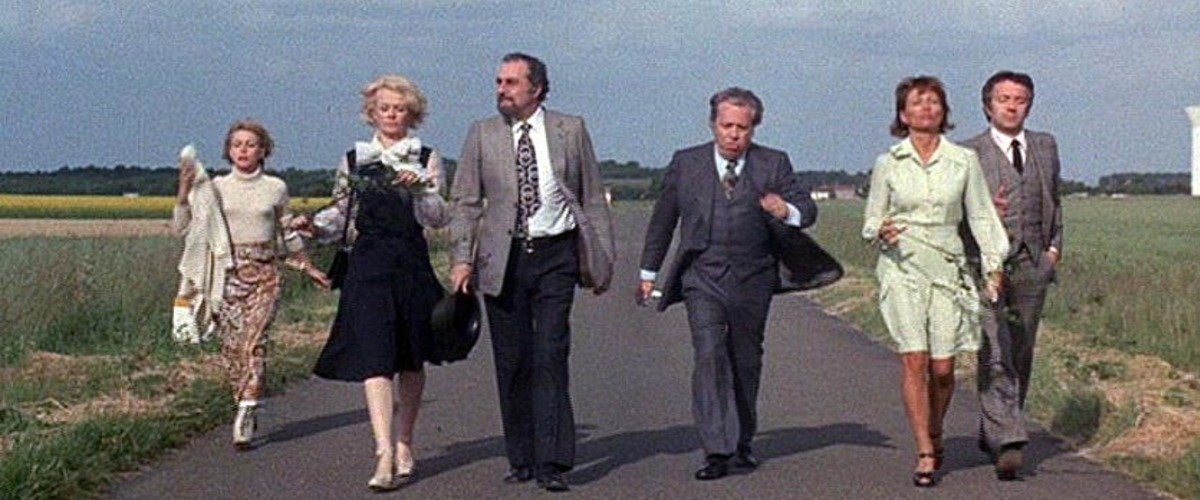
Going out for dinner
bizarre as Un Chien Andalou (which means “A dog from Andalusia,” but does not have the whiff of a dog, either one from Andalusia or from anywhere else), but elements of surrealism are all over this movie.  Set in France, the film is essentially about six people--Rafael, a diplomat from a fictional Central American country, who is also a drug trafficker; his friends the
Thévenots, a married couple of some importance; Mrs. Thévenot's alcoholic sister, Florence; and the Sénéchals, Alice and Henri—as they try to have dinner together, repeatedly interrupted or otherwise thwarted from having their meal together.

Un Chien Andalou
The first time they all go to their friend Alice’s house for dinner, but Alice informs them they were supposed to come the next day.  They all go out to a nice restaurant instead, but find that the owner is dead and laid out in the main dining room.  Another time they show up to Alice’s house, but cannot find the Sénéchals, as she and her husband suddenly had an urge to go have sex in the garden just outside.  (Noteworthy is that Alice is played by Stéphane Audran, who plays the title role in Best Foreign Film Babette’s Feast a decade and half later).   Returning to the house with hay all over themselves, they find their friends have taken off.  They will try it again another time.

Comedy is a part of this, but this is mostly social commentary.  The ambassador (played by Fernando Rey, the French connection in 1971’s The French Connection) and the others are all petty hypocrites, only interested in their own pleasures and looking down at those beneath them in social standing.  But because this is a surrealist film, often times one has no idea if what is shown actually happened or was someone’s dream.  We also don’t know if people are real or are ghosts, or if violence that occurs actually happens. 
Fernando Rey as Rafael
 
The Discreet Charm of the Bourgeoisie is a head-scratcher and likely would take several screenings to understand it.  Nonetheless, there are great sequences that keep you engaged, even you aren’t quite sure what they mean.  The cast is also excellent, especially Rey, who is at once dignified and morally suspect, the perfect persona for the point Bunuel was making about the bourgeoisie.  I think.

The title:  En français:  Le Charme discret de la bourgeoisie.  The term “discreet charm” is used sarcastically, to indicate how beneath the surface, these people lack true dignity and grace.

The Culture:  Nothing particularly instructive about French culture, other than dinner parties seem to be a big thing.

Dali's The Persistence of Memory
Agenda danger:  The movie is pretty upfront about its point:  It is those in charge or well-off who are being put under the microscope here.

Best Picture that year:  The Godfather

Rating:  Buñuel is considered one of the great film makers of the 20th century.  What makes him impressive, I think, is that he went against conventions and made films about things that interested him, popularity be damned.  That said, I can’t say that I like the confusion that happens after watching from a film like this.  A second viewing may be just what I need, but for now, I will just say that if you feel, as I do, that a little weirdness is welcome in the arts, as long as it’s not weirdness for its own sake, this film will entertain you and make you think a little.  About what, I have no idea.