Showing posts sorted by relevance for query Yesterday, Today and Tomorrow. Sort by date Show all posts

Tuesday, June 27, 2017

1964 Winner, Yesterday, Today and Tomorrow


Yesterday, Today, and Tomorrow

Director:  Vittorio de Sica

Distributed by:  Embassy Pictures Corporation

Released:  December 1963

Country:  Italy

Plot, photography, acting—among other things, those are the cornerstones of a great film.  But star power in a movie should never be underestimated.  And Yesterday, Today, and Tomorrow, the 1964 Best Foreign Film from Italy, has three stars that make this film pure entertainment. 

First, there’s Sophia Loren.  I’m 50, and to me, Loren has always been more of a name from the past than an actress, one of many women in past cinema that might have been fun to watch years ago, but held no interest for me.  But in this film, you really see that not only is she great Italian eye-candy, but a very funny actress who knew exactly how to get an audience to like her.  Then there is Marcello Mastroianni, one of Italy’s best known actors, who does a great job supporting Loren as a straight man.  And thirdly, Vittorio de Sica, Italy’s lesser known (to Fellini) legendary director, usually filming more heady subjects, shows his talent for making a colorful and entertaining popcorn flick.
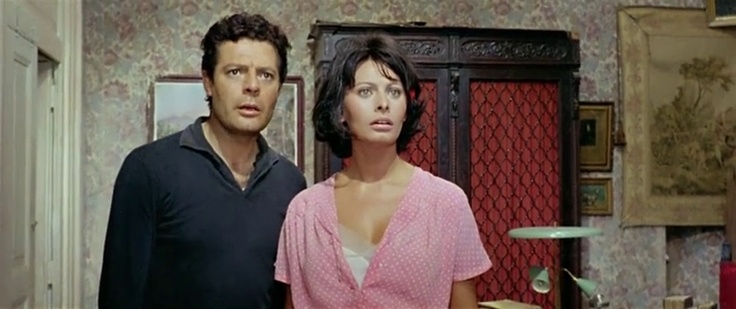
Mastroianni and Loren the Adelina of Naples section
And that is exactly what this is—a popcorn flick.  In fact, it's pretty much three popcorn flicks in one.  There are three separate stories, with Loren and Mastroianni playing different characters in different parts of Italy, like three sitcoms in a row.  The parts are named as the characters Loren plays and where the part of the film is set.

Part One, my favorite of the three, is called “Adelina of Naples.” Loren plays Mastroianni’s wife, who sells black market cigarettes in order to support her impoverished and growing family.  And her family does grow.  Italian law, it seems, prohibits a woman from being incarcerated if she is expecting.  So when the polizia come to arrest her for her illegal activities, she simply provides a doctor’s note, which forces the authorities to have to wait until after she has her child.  But once the baby comes, the only way for Loren to stay out of jail is for her to get pregnant again.  And Mastroianni’s character is happy to oblige.  Several times.  But sooner or later, he has to run out of energy, both to raise the many kids and to do his part in making them.

The famous striptease scene
The second section, “Anna of Milan,” has Loren as a Rolls Royce-driving wife of a rich absentee husband, picking up Mastroianni, her presumed lover.  She handles the car about as well as Apolonia in The Godfather ("It's safer to teach you English!"), and Mastroianni has to figure out whether her driving and personality are worth the effort.  In the final part, "Mara of Rome,” Loren is a high-class prostitute and Mastroianni is her impatient client.  Loren’s neighbor is a pleasant young man about to go to the seminary to study to become a Catholic priest, with Loren unintentionally being a convincing argument for him to change his plans. The section includes a memorable strip scene ending in frustration for Mastroianni.

Matthau and Loren, Grumpier Old Men
Yesterday, Today, and Tomorrow was a fun movie to watch.  Between 1961 and 1964, DeSica would make three movies with Loren and Mastroianni, with Loren winning for Best Actress for Two Women in 1961, and nominated for the same award in 1964’s Marriage, Italian Style.  Maybe she shows her acting chops more seriously in those films, but in Yesterday, Today, and Tomorrow, with help from Mastroianni and her director, she shows why she was such a star.

The Title:  Ieri, oggi e domain.  Good Italian titles seem to come in threes, with my favorite being Sergio Leone’s Il buono, il brutto, il cattivo (a.k.a., The Good, the Bad and the Ugly).  I just wish whoever translated these titles into English had learned to use the Oxford comma properly!

Please use Oxford commas!
The culture:  De Sica shows Italy in three forms:  Small town Italy, where the poor couple lives; glamorous Milan, where Loren unsafely tools around in her luxury automobile; and urban Rome, where future priests and current prostitutes can live next door to each other.  I especially liked how the director transitioned the segments of the film by panning out of the locale and allowing to camera to drift to the next locale.

Agenda danger:  There’s no agenda with a film this fun.

Best Picture that year:  My Fair Lady.

Rating:  It’s refreshing when the Academy rewards good comedy, which is to say, it doesn’t reward it enough.  Loren and Mastroianni, who starred in the previous year’s Best Foreign Film by Fellini, (to be reviewed next week), seem to be made to act together.  For me, Loren is no longer just the old Italian lady who was in Grumpier Old Men (1995) with Jack Lemmon and Walter Matthau.  She is a real star.

Tuesday, October 24, 2017

1947 Winner, Shoeshine


Shoeshine

Director:  Vittorio De Sica

Distributed by:  Lopert Pictures

Released:  April 1946

Country:  Italy

In 1956, Federico Fellini won the first competitive Academy Award for Best Foreign Language Film for LaStrada, and it made him internationally famous.  He is the most widely known director from the country, Italy, that has won the most Best Foreign Film statues.  But before the Academy started the competitive award, it handed out eight Honorary Awards to films made in a language other than English in order to promote more of a relationship between American and International film.  The very first one of these special awards was given to Shoeshine, a neorealist film by Italian director and actor Vittorio De Sica.  De Sica may not be as known to Americans as Fellini is, but Shoeshine is the first of four Oscar winners De Sica would win during his long career.  That's as many as Fellini won.

Pasquale and Giuseppe bargain with the fortune teller
Shoeshine is a film about two young Italian chums, Giuseppe and Pasquale, who have a common goal: to own their own horse.  To earn money to achieve this, they shine the shoes of passers-by on the streets of post-war Rome.  They both know that they could shine a thousand pairs apiece and still not have enough to buy and board the horse they want, so when the opportunity comes to make some real dough, they jump on it.  Giuseppe’s older brother is in with some crooks who ask the boys to sell some expensive (and presumably stolen) blankets to a nearby fortune teller.  The boys are told that the higher they negotiate the price, the more they will get.  But during the negotiations, the police swoop in and accuse the boys of selling stolen goods, taking them away.  Only the police look a heck of a lot like the criminals who gave them the blankets to sell in the first place.  The fake cops take the boys out of the apartment and tell them to hit the bricks, allowing them to keep whatever the woman gave them for the blankets.  They are so happy to have enough to buy their horse that they don’t even consider what Giuseppe’s brother and his friends really had in mind—to rob the fortune teller blind.

No more shines for these two.
So Giuseppe and Pasquale are riding along on their new horse like war heroes through the streets of Rome when some real police and the fortune teller stop them.  She insists these are the boys that set up the robbery of her place, and not being stool pigeons, they keep their mouths shut.  Giuseppe, the younger and the more plucky of the two, is adamant that they not rat out his brother.  The boys are put in juvenile detention while they await their fate, split up and put into cells with four other kids each.  They will have to make it without each other for a while, and make new friends and avoid new enemies.  You get the feeling it won’t end well.

Shoeshine is a story about loyalty and what the definition of that word means.  As a prime example of Italian neorealism, like De Sica’s masterpiece of two years later, The Bicycle Thief, the characters are played by non-actors, making it seem all the more true-to-life.  It’s hard not to hope for the best for these boys, yet there is always a sinking feeling that it won’t work out.  It’s like being a Cleveland sports fan.

"Hey Tommy, now go home and get your !@#$% shinebox!"
The Title: SciusciĆ .  The job of a shoeshine boy was important in post-war Italy, what with all the poverty.  Believe it or not, there are a number of famous folks who started out as shoeshine boys, such as Malcolm X, Sammy Sosa, and James Brown.  Most notably, Tommy DeVito in Martin Scorsese’s Goodfellas was a shoeshine boy when he was a kid, as Billy Batts, mobster fresh out of prison, reminds him repeatedly.  Batts doesn’t make too many more memories after that.

The culture:  Poverty in post-war Europe led to desperation in some cases, with crime rising as the best way to feed your family.  Certainly the shoeshine boys mixed up in the rip-off of the fortune teller looked the other way so they could forget about their miserable lives for a little and live the dream of having their own horse. 

Agenda danger:  The movie gives a hard look at how to deal with kids who aren’t quite as bad as the
The Bowery Boys, a.k.a, the Dead End Kids
crimes they commit.  Giuseppe and Pasquale both are good kids at heart, but once they get thrown into a prison of kids that look like the Bowery Boys, they have to adapt to survive.  The film pulls no punches in showing how bleak and soul-sucking such an atmosphere can be for kids who one would hope still have a chance to turn things around.

Best Picture that year:  Gentleman’s Agreement

Rating:  The Bicycle Thief is rightly and widely praised as one of the greatest films ever made, but De Sica made three other films that won Best Foreign Film (including Yesterday, Today, and Tomorrow and The Garden of the Finzi-Continis), and Shoeshine should not be overlooked as one of Italy’s great films.  Like De Sica is somewhat overlooked in comparison to Fellini, Shoeshine is overshadowed by the greatness that is The Bicycle Thief.  And that is indeed a real crime.