Crouching
Tiger, Hidden Dragon
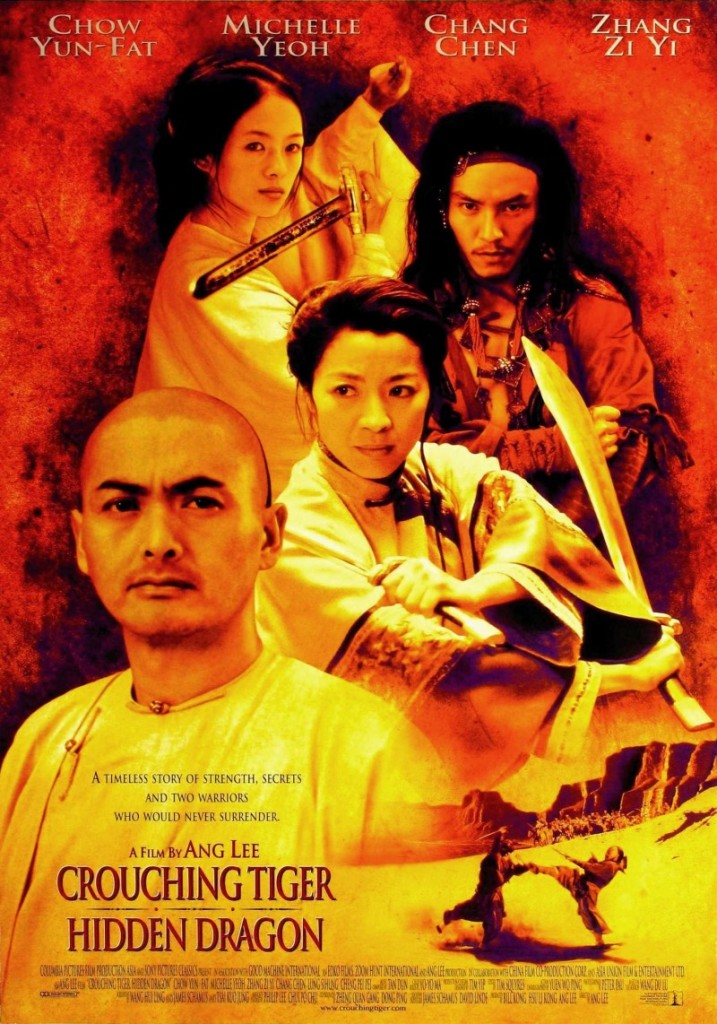 Director: Ang Lee
Distributed by: Sony Pictures Classics
Released: December 2000
Country: Taiwan
Suspension
of disbelief is a must for screening movies, watching pro-wrestling, and voting
for President. One has to have the
ability to put aside the obvious logical holes and buy into something that
cannot be true. In regard to the cinema,
it is the baseline for viewing any narrative film (a movie that tells a
fictional story) or documentary film made by Michael Moore (a documenatary that tells a fictional story).
Even
the most realistic films require that you accept things that may not make
logical sense—jumps in time and background music, for example, are aspects of a
film that make the story work, but don’t necessary follow the rules of
reality. Films with magic or science
fiction or singing dialogue are accepted by the audience because they know this
is part of the deal. But Crouching Tiger, Hidden Dragon is a film
with a realistic setting that asks us to put aside the laws of gravity for the
sake of the story.
 |
| Flying through the trees |
The
movie is set in 18th century China and centers on two
warrior-friends, one male and one female, played by Chow Yun-Fat and Michelle
Yeoh (I’m going to spare you the character names—no way I would be able to keep
them straight). Yun-Fat wants to retire
and is ready to part with his sword, “The Green Destiny.” He wants Yeoh (whom he has been in love with for years, maybe) to
deliver it to an old friend of theirs. While
in Beijing, Yeoh meets a young daughter of an aristocrat (played by Zhang
Ziyi—her character is Jen) who is supposed to marry some rich dude but really
would rather be a warrior like Michelle Yeoh.
One night The Green Destiny gets stolen and Michelle Yeoh goes after the
thief.
 |
| Bruce Lee |
Here
is where the suspension of disbelief comes in.
The next chase scene is just the first of a number of unbelievable
actions scenes. And when I say
unbelievable, I mean the laws of gravity are completely thrown out the
window. People are literally flying all
over the screen. And it’s great to
watch! Like watching Pro Wrestling or TV
reality shows, if you can shelve your logic, you can sit back and enjoy this
film.
Director
Ang Lee has made his name in mainstream films in a variety of genres: Brokeback Mountain, Sense and
Sensibility, and Life of Pi, to name a few. This
movie is an homage to the old Hong Kong martial arts films with stars like
Jackie Chan and Bruce Lee. Just as
Spielberg and Lucas honored the old serials from the 30’s and 40’s when they made Raiders of the Lost Ark and Star Wars, respectively, Lee honors
his genre without irony. The
cinematography and choreography are phenomenal, and the fighting and chase
scenes would be enjoyable even if there were no story. The point is, even if you don’t know what the
hell is going on, it’s a fun one to watch.
 The Title: 卧虎藏龙. Now that’s simple Chinese; I didn’t want to
confuse you by using the traditional script.
The title comes from an old Chinese saying about a situation with
unnoticeable masters, as in tigers and dragons just around the corner. Or else it means you have talents you should
hide and pull out only when you need them, like the ability to run on treetops
or do triple spins with your sword.
Again, I think if you are trying to figure out meaning here, you are
probably the same kind of person who reads into the plots of shows like Kung Fu
or CHiPs. Let it go.
The Title: 卧虎藏龙. Now that’s simple Chinese; I didn’t want to
confuse you by using the traditional script.
The title comes from an old Chinese saying about a situation with
unnoticeable masters, as in tigers and dragons just around the corner. Or else it means you have talents you should
hide and pull out only when you need them, like the ability to run on treetops
or do triple spins with your sword.
Again, I think if you are trying to figure out meaning here, you are
probably the same kind of person who reads into the plots of shows like Kung Fu
or CHiPs. Let it go. The Culture: More important culturally than learning about China in the 1700’s is the homage to Hong Kong movie-making that this film is. The movie is of a genre called “wixia (pronounced WAHK-see-ya),” which concerns martial arts in ancient China. The movie is actually based on a book in a series called the Crane-Iron series, which you cannot find in English.
Agenda Danger: Harmless new-agey philosophy is on display;
nothing you wouldn’t see get in watching an anime or playing “Zelda: Ocarina of Time.”
 |
| Link in Ocarina of Time |
Best Picture that year: Gladiator.
Crouching Tiger Hidden Dragon
was actually also nominated, as was Ang Lee for Best Director.
Rating: A very fun movie to watch, especially on the
big screen (as I did when it came out), even if when you walk away you have no
idea what happened.


